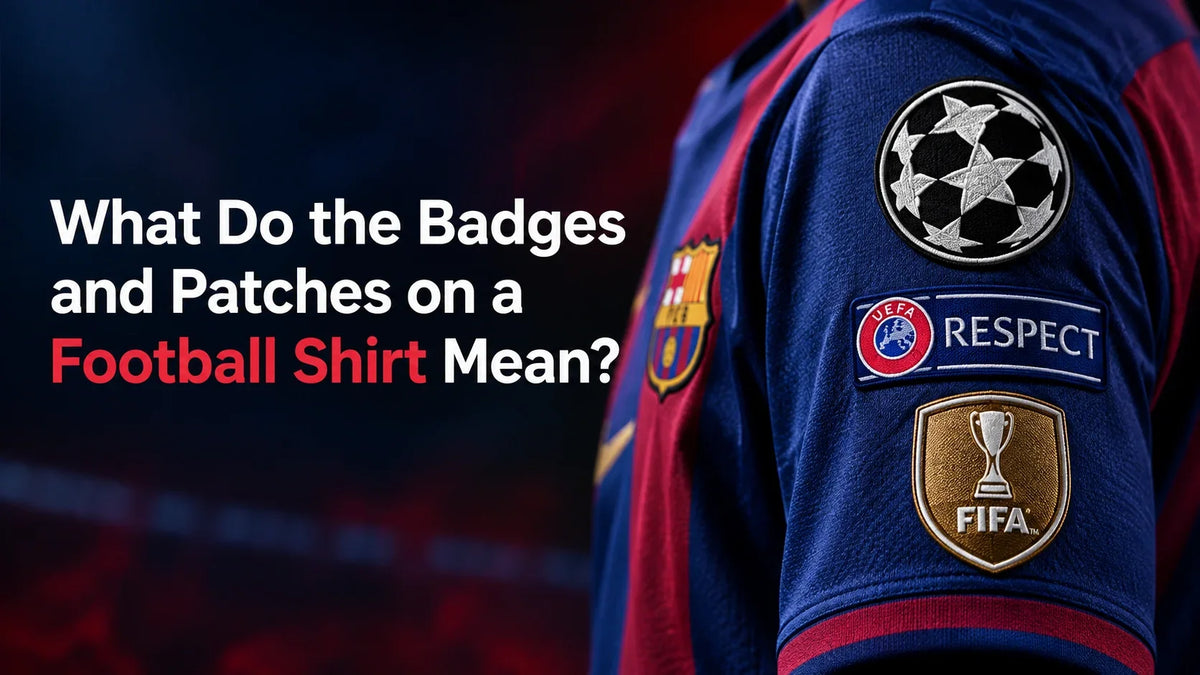
A football shirt is covered in badges and patches, and each one tells you something. They reveal which club or country it belongs to, which competition it was worn in, and how many titles have been won. Once you know what to look for, the shirt reads like a story. This guide explains what every badge and patch on a football shirt means.
What are the main badges on a football shirt?
The club or country crest, the kit-maker logo, the shirt sponsor, and any competition badges or championship stars.
What do the gold stars above a badge mean?
They usually mark major titles: World Cup wins for countries, or league titles for clubs, often one star per set number.
What is the badge on a Champions League shirt sleeve?
The starball or title-holder badge, with a special badge of honour for clubs that have won the trophy five times or three in a row.
What is the scudetto on an Italian shirt?
A small shield in the Italian tricolour, worn by the reigning Serie A champions for the following season.
Key takeaways
- The crest shows the club or country's identity, the maker logo shows the brand, and the sponsor is the commercial partner.
- Gold stars usually mark major honours: World Cup wins for nations, league titles for clubs.
- The Champions League badge of honour is worn only by clubs with five European Cups or three in a row.
- The scudetto is the Italian tricolour shield worn by the reigning Serie A champions.
- Sleeve patches also cover competitions, captaincy, remembrance and social campaigns.
A quick guide to football shirt badges
Before the detail, here is a quick reference to the badges you will spot most often, and what each one signals.
| Badge | What it means | Who wears it |
|---|---|---|
| Club or country crest | Identity, history and home | Every team |
| Kit-maker logo | Who made the shirt | Every team |
| Shirt sponsor | Commercial partner | Most club shirts |
| Champions League starball | Playing in the Champions League | All teams in the competition |
| UEFA badge of honour | Five European Cups or three in a row | A handful of elite clubs |
| Premier League gold badge | Reigning English champions | The current title holders |
| Scudetto | Reigning Serie A champions | The current Italian champions |
| Gold stars | Major titles won | Top clubs and nations |
Football shirt badges and patches explained
Here are the twelve badges and patches you are most likely to find on a shirt, and exactly what each one means.
1. The club or country crest
The crest is the heart of the shirt, showing the club or country's identity. It often carries the founding year, the city, and symbols tied to local history, like the wolf on Roma's shirts or the liver bird on Liverpool's kits. National crests usually feature the country's football federation instead. The crest is what makes a shirt instantly recognisable across the world. It is the one badge that never changes from season to season, which is why it anchors every design.
2. The kit-maker logo
The kit-maker logo shows who made the shirt, such as Nike, Adidas or Puma. It sits on the chest, usually opposite or above the crest. The logo is also a quick way to date a shirt, since clubs change manufacturers every few years. Each maker uses its own fabrics, fits and detailing, which is one reason the difference between player and fan jerseys comes down partly to the brand. For collectors, it is one of the first things to check when placing a shirt in its era.
3. The shirt sponsor
The shirt sponsor is the commercial partner, printed large across the front. Many shirts now carry a second, smaller sponsor on the sleeve as well. Sponsors change often, which makes them another useful way to date a shirt. National team shirts usually have no front sponsor, keeping the crest clear, as you see across the national football kits range. The sponsor is the busiest and most commercial part of most modern club shirts.
4. The Champions League starball
The Champions League starball marks a shirt worn in Europe's biggest club competition. Every team in the competition wears it on the sleeve, and the current holders wear a special title-holder version. It only appears in Champions League matches, not domestic games. Spotting it tells you the shirt saw European nights. It is one of the most desirable patches for collectors of match-worn shirts.
5. The UEFA badge of honour
The badge of honour, or multiple-winner badge, is the most prized of all. It is worn only by clubs that have won the European Cup five times or three seasons in a row (UEFA badge of honour, Wikipedia). Just a handful qualify, including the club behind the best Real Madrid kits of all time, along with AC Milan, Liverpool, Bayern Munich, Barcelona and Ajax. The number of titles is shown on the badge itself. It is a mark of true European royalty that most clubs will never wear.
6. The Premier League gold badge
Every Premier League shirt carries the league's lion badge on the sleeves. The reigning champions wear a special gold version the following season, while everyone else wears the standard one. These sleeve badges only appear in league matches, not cup or European ties. They are a quick way to tell a Premier League shirt apart. The gold badge is a one-season badge of pride for the champions.
7. The Italian scudetto
In Italy, the reigning Serie A champions wear the scudetto, a small shield in the green, white and red of the Italian flag. It was created in the 1920s, and winning the scudetto simply means winning Serie A. It is worn for the whole season after the title is won, and only one club wears it at a time. It passes to the new champions each year. It is one of the most elegant champions' marks in world football.
8. National team gold stars
For national teams, the gold stars above the crest mark World Cup wins, one star per title, as shown proudly across the best national team jerseys ever released. Brazil wear five, Italy and Germany four, and Argentina three. Uruguay are the famous exception, wearing four that count two World Cups and two early Olympic golds FIFA recognises as world titles. The stars are a shorthand for a nation's place in football history. They are worn with enormous pride at every tournament.
9. Club gold stars
For clubs, stars usually mark league titles rather than European ones, though the rule changes by country. Juventus started the trend in 1958 for reaching ten Serie A titles, with one star often standing for a set number of championships. In Germany, three Bundesliga titles earn one star, five earn two, and ten earn three. In Major League Soccer, a club adds a star for each MLS Cup. Because the system varies, it is always worth checking the local rule before you read them.
10. The captain's armband
The captain wears an armband, which marks the team leader on the pitch. It often carries a league logo or a campaign message, and some promote causes like inclusion or respect. It is the one piece of kit that moves from player to player during a match. Spotting it tells you who leads the side on the day. It is a small but meaningful part of the kit.
11. Social and charity patches
Shirts often carry small patches for social causes, such as anti-racism or respect campaigns. Around Remembrance Day, many English clubs wear a poppy on the shirt. These patches reflect the game's wider role beyond results. They are usually worn for specific rounds of matches rather than a whole season. They turn a shirt into a snapshot of a moment in time.
12. Commemorative and anniversary patches
Clubs add special patches to mark anniversaries, finals or tributes to a person or moment. A club's 100th or 125th year often gets its own dedicated badge. These are exactly what make a shirt collectible, which is why one with a rare patch is often the most sought-after version in the retro football jerseys market. They tie a kit to one occasion rather than a whole era. For collectors, a commemorative patch can make all the difference.
National team World Cup stars, by country
The star systems can be confusing, so here is a quick look at the leading nations and what their stars mark.
| Country | Stars | What they mark |
|---|---|---|
| Brazil | 5 | Five World Cup wins |
| Italy | 4 | Four World Cup wins |
| Germany | 4 | Four World Cup wins |
| Argentina | 3 | Three World Cup wins |
| Uruguay | 4 | Two World Cups and two Olympic golds |
Why badges matter for collectors
For collectors, the badges are a big part of a shirt's value and story. A match-worn shirt with a Champions League final patch is worth far more than a plain league version. Commemorative and one-season badges make certain shirts genuinely rare, and the crest, maker and sponsor together help date a shirt and spot a fake football shirt. Correctly placed, crisp badges are a key sign of a genuine kit. The details on the fabric are where a shirt's history, and its value, really live.
Final thoughts
The badges and patches on a football shirt turn it into a record of identity and achievement. The crest, maker and sponsor tell you the basics, while competition badges, the scudetto and gold stars reveal a club or country's biggest honours. Smaller patches add the story of a single season or cause. Once you can read them, every shirt says more, so take a close look the next time you pull on one of your football jerseys and see the whole history on the fabric.
FAQs
What do the badges on a football shirt mean?
The main badges are the club or country crest, the kit-maker logo and the shirt sponsor, plus any competition badges and championship stars that mark honours.
What do gold stars on a football shirt mean?
They usually mark major titles. For countries, stars represent World Cup wins; for clubs, they usually represent league titles, often one star per set number of titles.
Which clubs wear the Champions League badge of honour?
Only clubs that have won the European Cup or Champions League five times or three seasons in a row, including Real Madrid, AC Milan, Liverpool, Bayern Munich, Barcelona and Ajax.
What is the scudetto?
A small shield in the Italian tricolour worn by the reigning Serie A champions for the following season. Winning the scudetto means winning Serie A.
Why do national teams have stars on their shirts?
The stars represent World Cup wins. Brazil have five, Italy and Germany four, and Argentina three, while Uruguay's four include two World Cups and two early Olympic titles.